New comet C/2011 Y3 (Boattini)

C/2011 Y3 (Boattini) was discovered by Andrea Boattini on 2011, Dec. 25.24 with the 1.5-m f/2 reflector + CCD from Mount Lemmon Sky Survey (part of the Catalina Sky Survey). He described the comet as being very diffuse with central condensation: four 30-s exposures show a 6″ coma and a wide fan-shaped tail about 30″ long in p.a. 240-245 deg.
It was subsequently placed on the NEO Confirmation Page, where other observatories (including me at 204, H. Sato from I89-Nerpio, R. Holmes et al. from H21-ARI, P. Bacci et al. from 104-San Marcello Pistoiese, A. Novichonok et al. from C32-TAU station of Ka-Dar Observatory, R. Ligustri from H06-RAS and J. Lacruz from J87-La Canada) confirmed its cometary appearance.
I observed it less than 18 hours after the discovery: conditions were good so it was quite easy to confirm it as a comet. I measured a very diffuse 10″ coma and a broad tail at least 25″ long in p.a. around 250 deg.
Results were published in CBET 2959 (subscription required) and astrometry, together with preliminary parabolic orbital elements, in MPEC 2011-Y50.
This marks the 21st comet discovery for Andrea Boattini!
Here is the image:

Posted in Uncategorized | Leave a comment

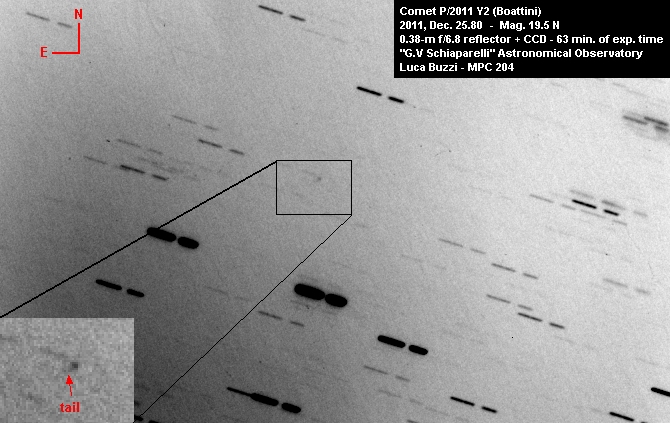
New comet P/2011 Y2 (Boattini)

P/2011 Y2 (Boattini) was discovered by Andrea Boattini on 2011, Dec. 24.12 with the 1.5-m f/2 reflector + CCD from Mount Lemmon Sky Survey (part of the Catalina Sky Survey). He described the comet as having a very condensed 5″ coma and no sign of a tail in 3″ seeing.
It was subsequently placed on the NEO Confirmation Page, where other observatories (including me at 204, H. Sato from I89-Nerpio, R. Holmes et al. from H21-ARI and P. Bacci et al. from 104-San Marcello Pistoiese) confirmed its cometary appearance.
I observed it the night following the discovery: transparency and seeing were good, but it was not easy to confirm it as a comet. I measured a 8″ coma slightly elongated in p.a. 140 deg.
MPC also found some prediscovery observations back to Sept. 4.
Results were published in CBET 2958 (subscription required) and astrometry in MPEC 2011-Y49.
Here is the image:

Posted in Uncategorized | Leave a comment

New comet P/2010 UH55 (Spacewatch)

2010 UH55 was discovered by the Spacewatch survey on 2010 Oct. 29; it was soon clear that with its peculiar orbital elements and a Tj=2.61, 2010 UH55 could be in a possible cometary orbit. Earlier observations made remotely by H. Sato with a 0.51-m f/6.8 reflector from RAS Observatory (H06) on 2010, Nov. 17 reveal its possible softness and a hint of a tail on the west side.
He again observed it almost a year later (2011, Nov. 3) confirming its cometary appearance. He then contacted the T3 mailing-list, and I was able to observe it on Nov. 15 with a 0.38-m f/6.8 reflector from our observatory (204). That night had good seeing and transparency, but 83% Moon was 60° away. In a stack of images totalling 25 minutes of unfiltered exp. time (visible below) it has a compact coma 8″ wide and a faint tail 10-15″ long in PA 290°.
That feature was also confirmed by D. Chestnov and A. Novichonok remotely with a 0.40-m telescope at the TAU Station of Ka-Dar Observatory (North Caucasus, Russia) and from Sostero et al. using the 2.0-m Faulkes Telescope North at Haleakala.
Results were published in CBET 2923 (subscription required) and latest astrometry in MPEC 2011-W82, together with revised orbital elements.

Posted in Uncategorized | Leave a comment

New comet C/2011 Q1 (PANSTARRS)

C/2011 Q1 (PANSTARRS) was discovered on 2011, Aug. 20.44 by PANSTARRS team with a 1.8-m f/4 reflector + CCD from Haleakala, Hawaii, USA.
Richard Wainscoat, Marco Micheli, Henry Hsieh and Larry Denneau described it as having a FWHM of 1.2″ while stars have 1.0″.
It was subsequently placed on the NEO Confirmation Page of the Minor Planet Center under the temporary designation P1012v1 and after then, some observatories confirmed the cometary appearance, including us.
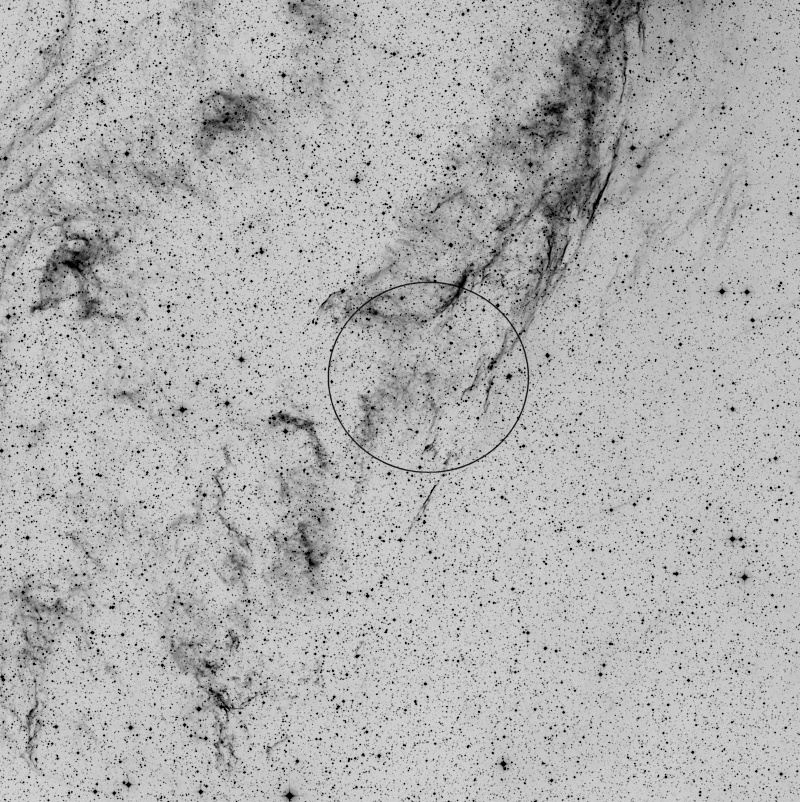
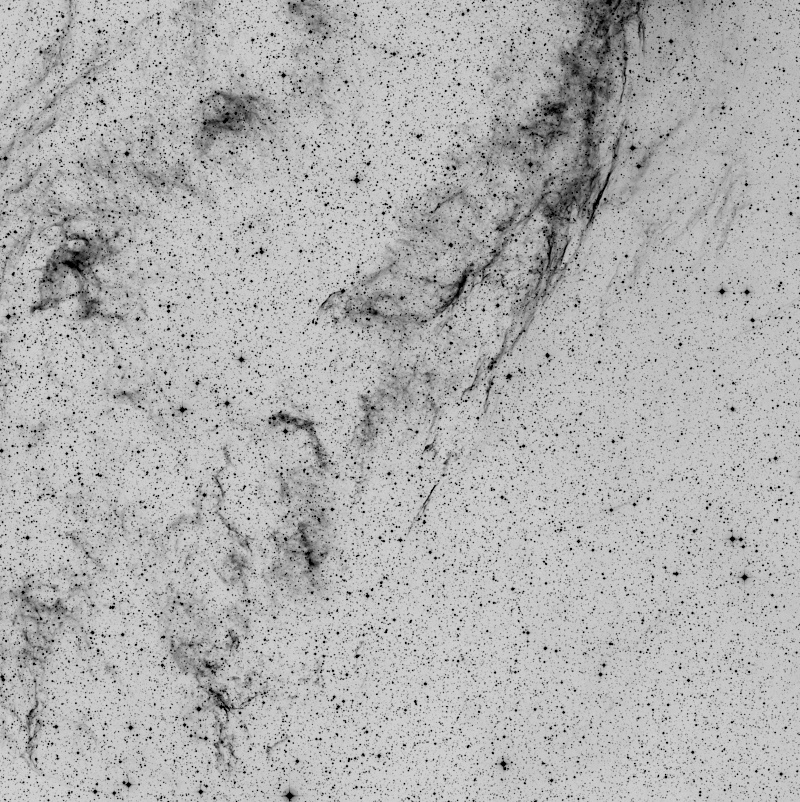
The field of view was crowded with stars and there was a vast nebulosity in the area (Veil Nebula in Cygnus) so I took over an hour of total exposure time, to be sure to have several images free of stars. The image below (old DSS field) gives you an idea of the field in which the comet was:


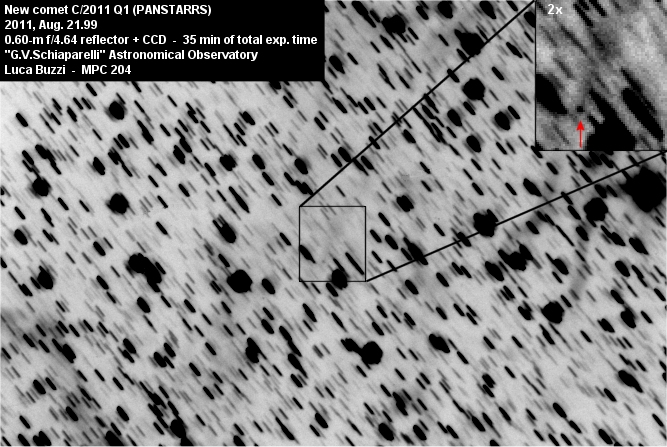
Stacking all the “good” images, it was quite obvious its cometary nature: FWHM was around 30% wider than stars nearby, with a 8″ compact coma and a tail several arcseconds long in PA around 340°, even if it was quite difficult to estimate due to a nebulosity in the area.
The discovery was announced on CBET 2790 (subscription required) and the astrometry, with a preliminary parabolic orbital elements, published on MPEC 2011-Q12.
This was the 4th comet discovered by PANSTARRS survey.
Below is the image:

Posted in Uncategorized | Leave a comment

C/2009 S3 & C/2008 FK75 close approach

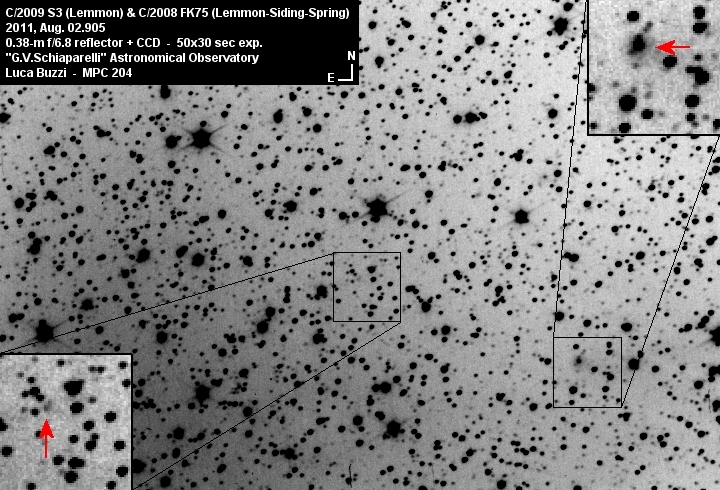
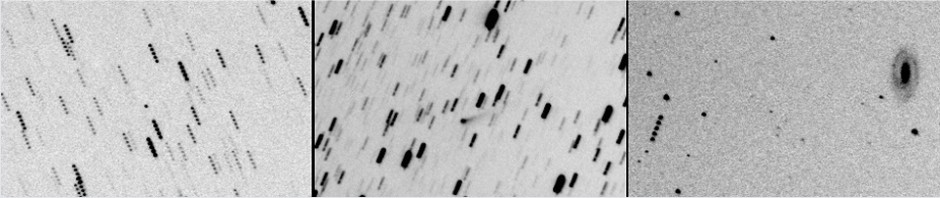
On the night between Aug. 2 and 3 I was able to catch the close approach of two comets, C/2009 S3 (Lemmon) and C/2008 FK75 (Lemmon-Siding Spring), thanks to a previous “alert” made by Seiichi Yoshida from comets-ml.
The field was crowded with stars (Milky Way in Lacerta constellation), but fortunately the comets are both visible, with an apparent separation in the sky of 5.5′ (their closest approach was on Jul. 28 = 2.3′).
On the left is the faintest of the two, C/2009 S3, at mag. 19.7 N. However I had to use a small aperture due to the presence of a star, so its real magnitude is probably closer to 19 rather than 20. At the time of the image, it was at delta=6.210 AU and r=6.534 AU.
On the right, C/2008 FK75 is more easily seen at mag. 17.7, at delta=4.794 AU and r=5.140 AU.
Here is the image:

Posted in Uncategorized | Leave a comment

First Earth Trojan asteroid discovered: 2010 TK7

Usually I update this blog with some interesting stuff done at Schiaparelli Observatory, but this time I will make an exception.
On July 27 a team led by Martin Connors of Athabasca University in Canada announced the discovery of the first Earth Trojan asteroid, 2010 TK7. Their work appeared in the current issue of the journal Nature.
2010 TK7 was originally discovered by NASA WISE survey on 2010, Oct. 01, then placed on the MPC NEO Confirmation Page, allowing astronomers to obtain some follow-up. It was observed for a 6-days arc, then recovered by Christian Veillet et al. using Canada-France-Hawaii Telescope on 2011 April 28-29, when it was at mag. 23.2 r.
Those observations were crucial to identify 2010 TK7 as the first Earth Trojan asteroid, which currently reside around L4 Lagrangian point, so leading the Earth in its orbit around
the Sun. It is estimated to be 150-500 meters across, depending on its albedo (from 0.25 to 0.04 respectively).
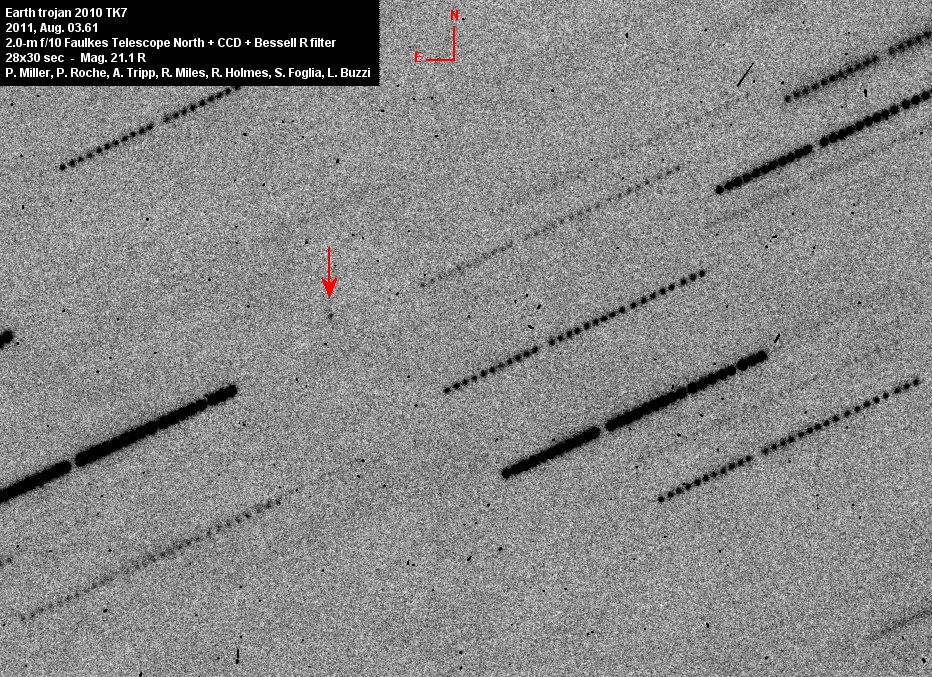
On Aug. 3, thanks to the Faulkes Telescopes collaboration (P. Miller, P. Roche, A. Tripp,
R. Miles, R. Holmes, S. Foglia and myself), I’ve been able to image it with the 2.0-m f/10
Faulkes Telescope North at Haleakala, in very good sky conditions (3% humidity, 1.1″ seeing, excellent transparency).
The result is below:

Now 2010 TK7 is in the southern constellation Fornax, so quite a bad place for northern observatories. In the next months it will be even worse, reaching declination -50° in November. Then it will start to move north, but never brighter than V=21 and less than 90° from the Sun.

Posted in Uncategorized | Leave a comment

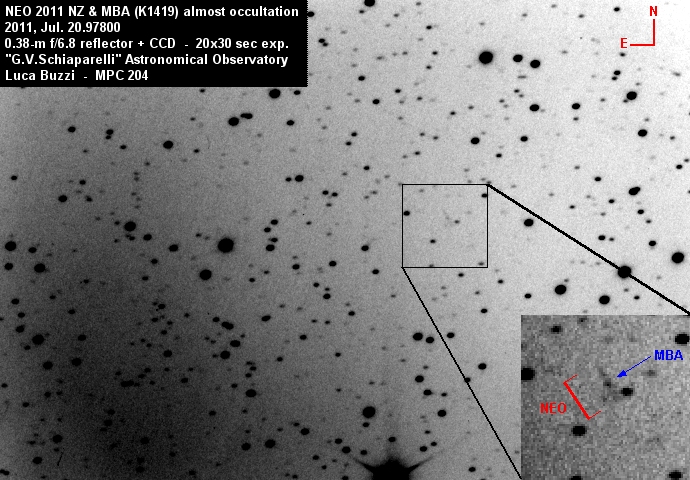
2011 NZ and the (almost) occultation of a MBA

It happens very often to have, in the same FOV of your target, another asteroid. Sometimes it can be a new one, but almost always it’s a known one. Sometimes it can be very near your target, but almost never it’s BEHIND your target.
That’s what’s happened to me during my last observing night (the 69th from the beginning of the year), between July 20 and 21. I was imaging NEO 2011 NZ, and I’ve noted that a MBA was very very close to it.
After stacking all my 20 images I measure them, with the appropriate motion vector for the both of them. The result was the following:
2011 NZ: 20h 11m 03.47s / -16° 51′ 53.1″
K1419:    20h 11m 03.50s / -16° 51′ 53.1″
If my math is correct, this means only 0.43″ from each other! That’s sounds pretty close!
In reality, the distance between them was 356.3 millions km (2011 NZ was 0.1944 AU from us while K1419 was at 2.5761 AU).
The image is not very good due to the presence of the Moon (71% 60° away), the altitude of the target (27°) and the bad seeing of that night.

Posted in Uncategorized | Leave a comment

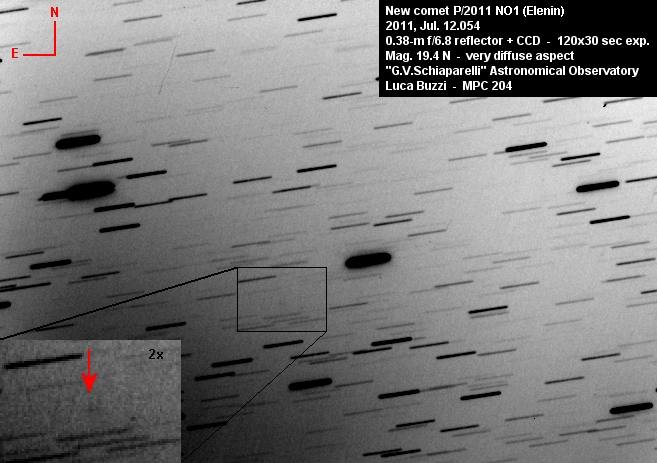
New comet P/2011 NO1

P/2011 N01 was discovered on 2011, Jul. 07.30 by Leonid Elenin and I. Molotov on four 240-s exp. taken with a 0.45-m f/2.8 reflector + CCD from their remote ISON-NM Observatory, New Mexico, USA.
They described it as having a slightly apparent cometary appearance. It was subsequently placed on the NEO Confirmation Page of the Minor Planet Center under the temporary designation MG27A07 and after then, several observatories confirmed
the cometary appearance, including us.
The first clear night in July here in northern Italy was between 11th and 12th. The sky was clear but quite hazy, especially at low altitudes, but the seeing was good.
I waited until the moonset, and I took as much exposures as possible, totalling 60 minutes. The object was in constellation Capricornus at an average altitude of 24°.
Due to the haziness of the sky, the images were not particularly good: the object appears diffuse with no clear central condensation or tail; in any case it is quite clear its cometary appearance.
The discovery was announced on CBET 2768 (subscription required) and the astrometry, with a preliminary periodic orbital elements, published on MPEC 2011-N09 and N10.
Below is the image (not very good, though):

Posted in Uncategorized | 1 Comment

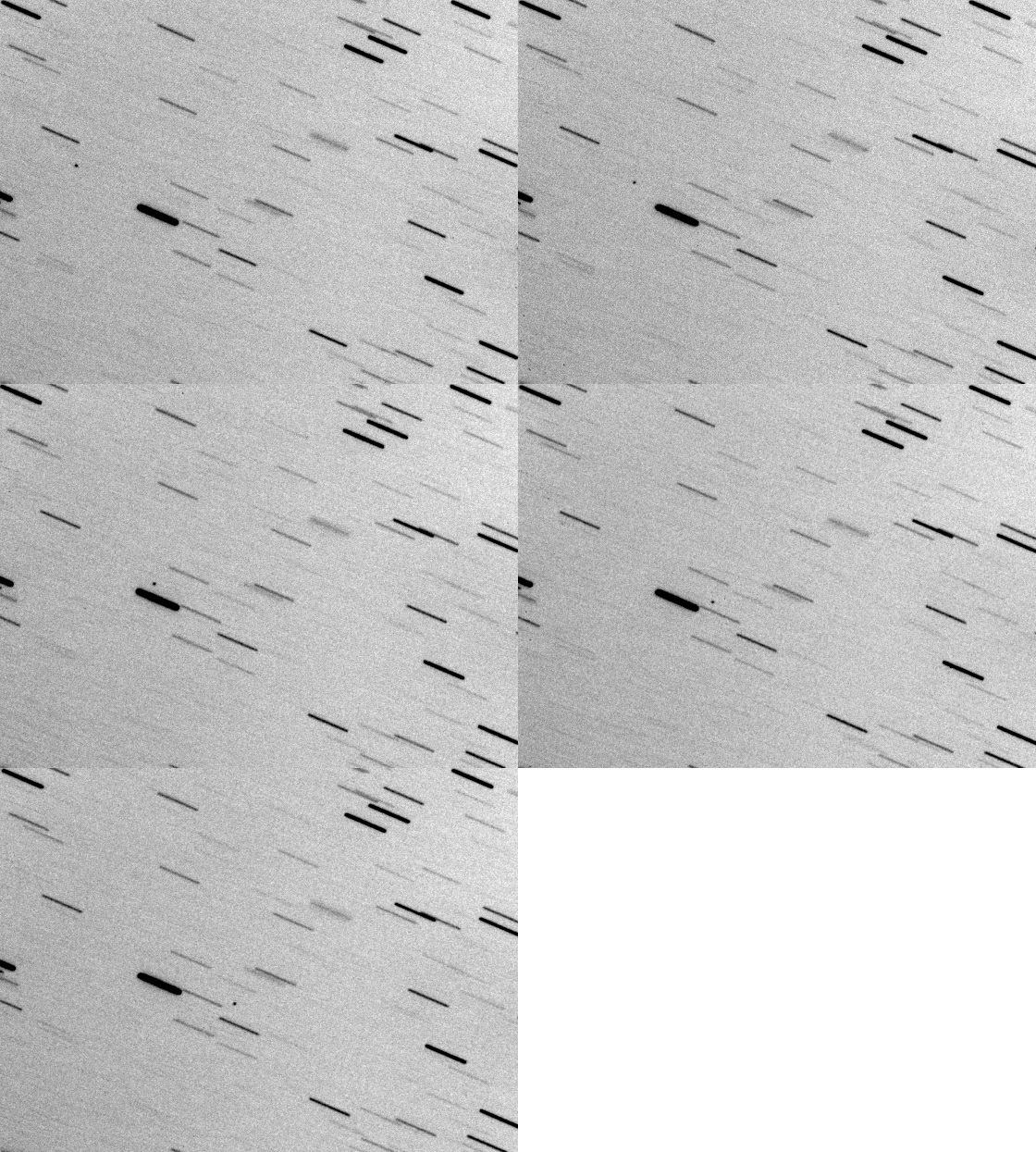
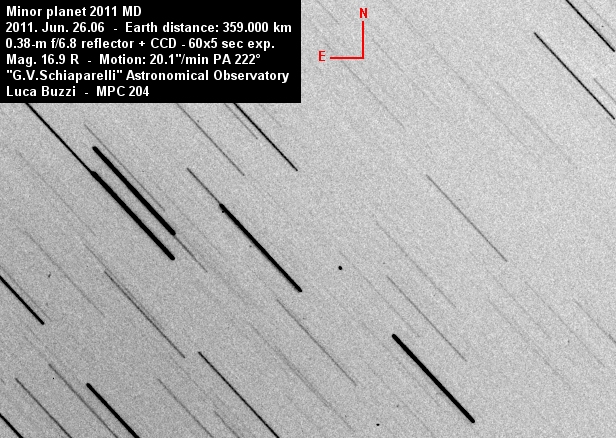
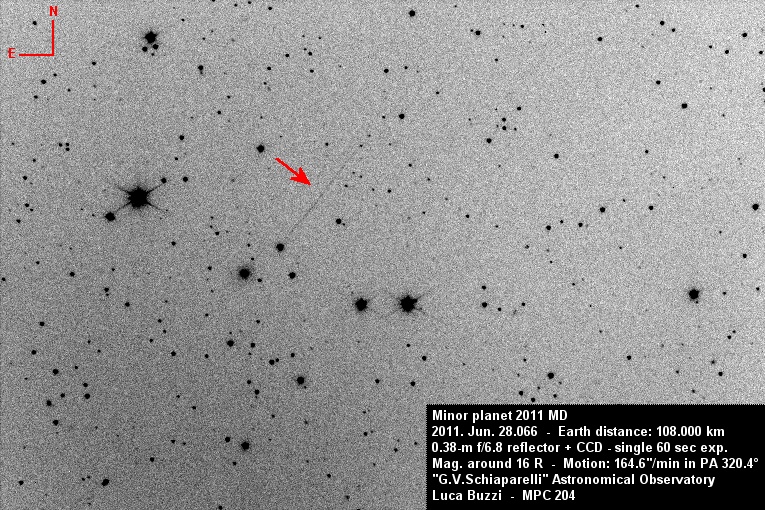
2011 MD close approach

2011 MD was discovered by the LINEAR survey on Jun. 22.26 and just from its first orbital parameters it was clear that it would pass very close to the Earth five days later.
We imaged it on Jun 24- 25, 26 and 28.
Here is an animation made of five 24×10 seconds images (each stacked on the motion of the asteroid) when it was around 550.000 km from Earth and approaching, from Jun. 24.938 to 24.954, moving in constellation Hercules (less than 2 degrees from globular cluster M13) at mag. 17.8 with a speed of 11.4″/min:


On Jun. 26.06 its speed almost doubled (20.1″/min) and its distance reached 359.000 km, just inside the Moon’s orbit:


Then it reached its perigee around Jun. 27.7 at about 12.000 km from the Earth surface (transit upon South Africa and Antarctic). After 8.5 hours I was able to make some astrometry. The session lasted from 01.27 to 01.45 UT, and in this time the asteroid quickly decelerates from 168 to 162″/min, so I had to keep the exposure time at 1 second! (and of course stack many images)! In the middle of the session I expose for one minute, and the result is visible below:

Farewell 2011 MD!

Posted in Uncategorized | 5 Comments

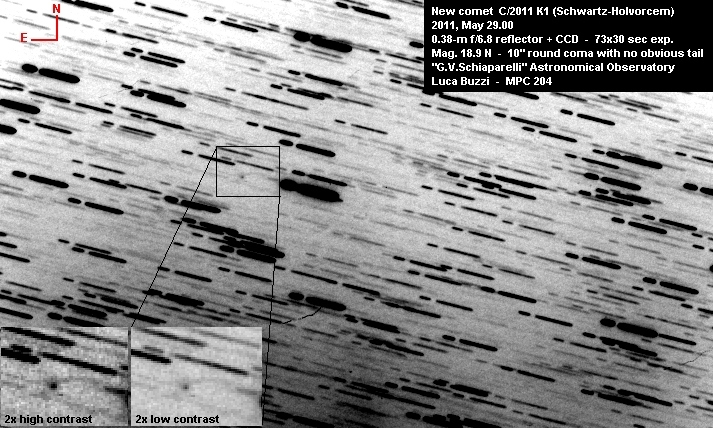
New comet C/2011 K1 (Schwartz-Holvorcem)

C/2011 K1 (Schwartz-Holvorcem) was discovered on 2011, May 26.25 by M. Schwartz and P. Holvorcem with the 0.41-m f/3.75 astrograph + CCD from Tenagra Observatory, Arizona, USA.
It was subsequently placed on the NEO Confirmation Page of the Minor Planet Center under the temporary designation TBKQ01.
I was able to image it two days after its discovery, on the night between May 28 and 29, thanks to the very good weather conditions all over the month, usually the rainest of the year here on my site; it was still in the NEO Confirmation Page, located in the sky in the constellation Ophiuchus.
The sky was clear with good seeing so I could confirm its cometary feature, even if the crowded star field made things a bit complicated.
In the total stack (36 min of exposure time) the comet has a FWHM 30-35% larger than stars nearby of similar brightness, with a 10″ round and diffuse coma, with no visible tail, even if a hint of a tail is only suspected extending to the north, but a trail of a star makes it difficult to judge.
The discovery was announced on IAUC 9211 (subscription required) and the astrometry, with a preliminary parabolic elements, published on MPEC 2011-L04.
Below is the image:

Posted in Uncategorized | Leave a comment