New comet P/2011 JB15 (Spacewatch-Boattini)

P/2011 JB15 (Spacewatch-Boattini) was originally discovered as an asteroid by Spacewatch team using the 0.90-m f/3 reflector + CCD from Kitt Peak, Arizona – USA, on 2011, May 8 and 12, and designated by the Minor Planet Center 2011 JB15.
On May 28.33 Andrea Boattini, in the course of the Mount Lemmon Sky Survey (part of the Catalina Sky Survey), Arizona – USA discovered an object he recognized as a comet with the 1.5-m f/2 reflector + CCD. It was subsequently placed on the NEO Confirmation Page of the Minor Planet Center under the temporary designation SK8D595.
I was able to image it two days after its discovery, on the night between May 29 and 30, thanks to the very good weather conditions all over the month, usually the rainest of the year here on my site; it was still in the NEO Confirmation Page, located in the sky in the constellation Serpens Cauda.
The sky was clear with good seeing so I could confirm its cometary feature: in the total stack (34 min of exposure time) the comet has a FWHM around 30% larger than stars nearby of similar brightness, with a 8″ compact coma elongated in PA around 250°.
The discovery was announced on IAUC 9210 (subscription required) and the astrometry published on MPEC 2011-K56, in which the MPC linked the object with 2011 JB15, thus the designation Spacewatch-Boattini.
This was the 17th comet discovered or co-discovered by Andrea Boattini (including 206P/Barnard-Boattini), the most prolific Italian comet discoverer of all time.
Below is the image:

Posted in Uncategorized | Leave a comment

New comet C/2011 J3 (LINEAR)

C/2011 J3 (LINEAR) was discovered on 2011, May 14.38 by the LINEAR survey with a 1.0-m f/2.15 reflector + CCD.
It was subsequently placed on the NEO Confirmation Page of the Minor Planet Center under the temporary designation BZ39121.
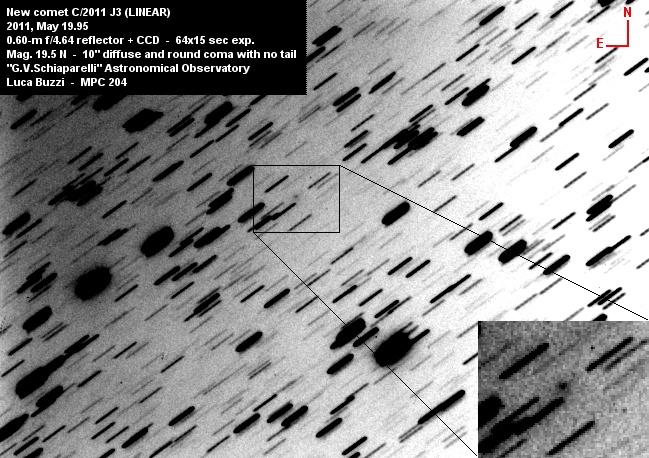
I was able to image it only 5 days after the discovery, on the night between May 19 and 20; fortunately it was still in the NEO Confirmation Page, located in the sky on the border between Cygnus and Cepheus.
The sky was clear with good seeing but the Moon interefered with the observations, as you can see from the gradient on the image below (92% Moon about 90° away), but nontheless I could quite easily confirm its cometary feature.
In this stack (16 min of total exposure time) the comet has a FWHM 50% larger than stars nearby of similar brightness, with a 10″ round and diffuse coma, with no visible tail.
The discovery was announced on IAUC 9209 (subscription required) and the astrometry published on MPEC 2011-K11.
Below is the image:

Posted in Uncategorized | Leave a comment

Our paper published in the Minor Planet Bulletin

Albino Carbognani (OAVdA – Osservatorio Astronomico Valle d’Aosta) and myself sent some weeks ago a paper describing the photometric behaviour of NEA 2010 WA9 to Prof. Richard Binzel, editor of the Minor Planet Bulletin.
This NEA showed an amplitude of 1.4 +/- 0.2 mag. over a period of 0.097 +/- 0.002 h.
Our article has just been published in MPB 38-2 (2011, Apr.-Jun.) and you can download it also at this link.


Posted in Uncategorized | Leave a comment

New comet C/2011 F1 (LINEAR)

C/2011 F1 (LINEAR) was discovered on 2011, Mar. 17.28 by the LINEAR survey with a 1.0-m f/2.15 reflector + CCD.
It was subsequently placed on the NEO Confirmation Page of the Minor Planet Center under the temporary designation BY58897.
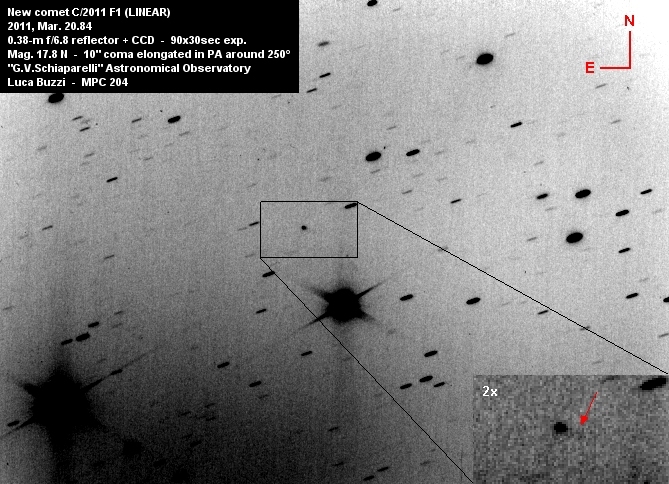
The first clear day here in northern Italy, after its discovery, was the night between Mar. 20 and 21; fortunately it was still in the NEO Confirmation Page.
The sky was clear with good seeing but with a strong moonlight (almost Full Moon 80° away), but nontheless we could confirm its cometary features.
Three separate stacks (each made by 30×30 seconds images) reveal a FWHM 30% larger than stars nearby of similar brightness.
A total stack of 90×30 seconds also reveals a faint elongation of the coma in PA 250°.
The discovery was announced on IAUC 9202 (subscription required) and the astrometry published on MPEC 2011-F15.
Below is our image:

Posted in Uncategorized | Leave a comment

2010 and first part of 2011 statistics

In the last days of February, the MPC published the update of the statistics of all observatories who contribute to the MP astrometry.
The page is visible at this URL:

http://www.minorplanetcenter.net/iau/special/CountObsByYear.txt

In 2010, we performed 2980 astrometric measurements of 744 asteroids and 131 comets. We are the first observatory in Italy for the number of asteroids observed, and the first in the world for the number of comets observed.
For the number of positions sent to the MPC we are at second place in Italy, after Castelmartini (MPC 160), thanks to the very good work done by my friend Enrico Prosperi (more than 6.000 positions of 426 asteroids and 79 comets).
Also the residuals are very good, with mean values of +0.01 +/- 0.28 in R.A. and -0.01 +/- 0.29 in DEC.

2011 has begun very well, thanks to many clear nights in January and February (over 50%, here in northern Italy it is very much!).
In the first 6 weeks of this year, we sent to the MPC 777 astrometric positions of 251 asteroids and 32 comets.
Residuals are +0.01 +/- 0.36 in R.A. and -0.05 +/- 0.24 in DEC.

Posted in Uncategorized | Leave a comment

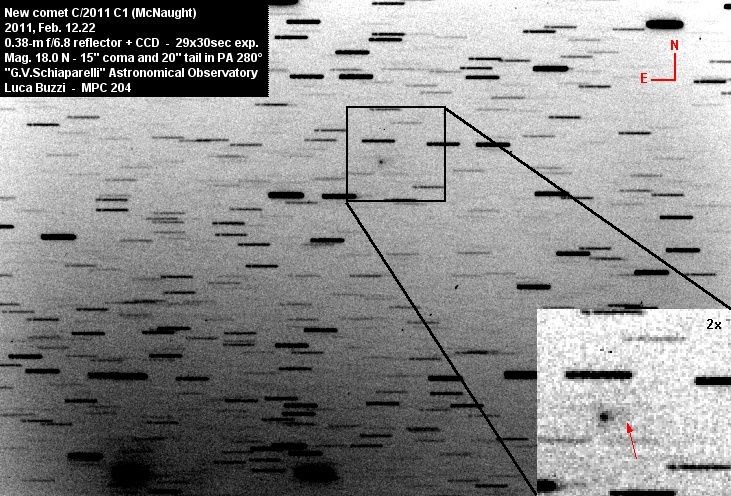
New comet C/2011 C1 (McNaught)

C/2011 C1 is the 58th comet found by Robert H. McNaught, the most prolific comet discoverer of all time.
It was discovered on 2011, Feb. 10.71 with the 0.5-m Uppsala Schmidt telescope + CCD during the course of the Siding Spring Survey (E12). It was subsequently placed on the NEO Confirmation Page of the Minor Planet Center under the temporary designation SC55D11.
Despite the weather forecast for the night of February 11-12, the sky remained clear here in northern Italy so I was able to image it just before dawn of Feb. 12 with our 0.38-m f/6.8 reflector + CCD. It was quite low (altitude around 25° when the Sun was 14.5° below the horizon) in the constellation Scorpius.
Fortunately the transparency and seeing were quite good so we could confirm its cometary nature (strong central condensation and a coma 15″ wide with a faint and broad 20″ tail around PA 280°).
The discovery was announced on IAUC 9197 (subscription required) and the astrometry published on MPEC 2011-C79.
Below is our image:

Posted in Uncategorized | Leave a comment

Our first Pan-STARRS confirmations

On the night between Feb. 01 and 02 the sky was very good so I’ve decided to confirm some faint targets in the NEOCP, at that time full of Pan-STARRS discoveries.
The majority of them were out-of-range for my equipment (fainter than mag. 22) but some of them had decent magnitudes (20-21).
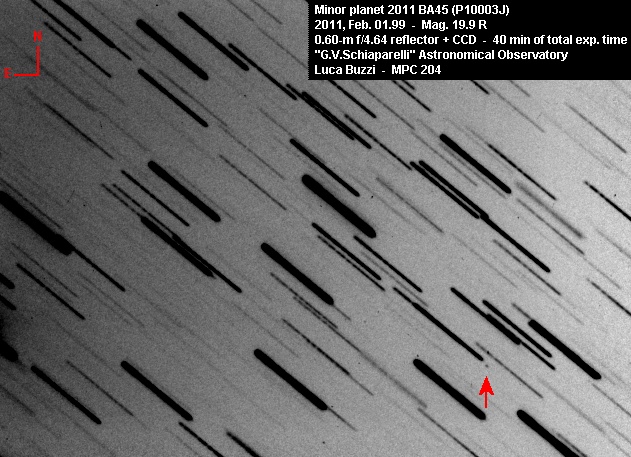
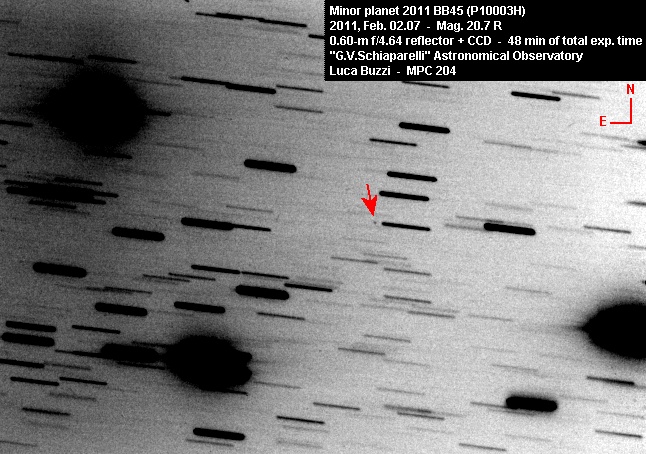
Images below represent our first two Pan-STARRS confirmations: P10003J and P10003H (respectively 2011 BA45 and 2011 BB45).
Especially this last one was one of our faint targets ever imaged (20.7 R).

P10003J = 2011 BA45 (astrometry on MPEC 2011-C05)


P10003H = 2011 BB45 (astrometry on MPEC 2011-C06)


It was good to see our 0.60-m between 2-m class telescopes!

Posted in Uncategorized | Leave a comment

The best January of all time

This last January has been the best since I’ve started observing.
In 12 nights I’ve observed 193 minor planets and 24 comets, with 607 astrometric measures sent to the MPC.
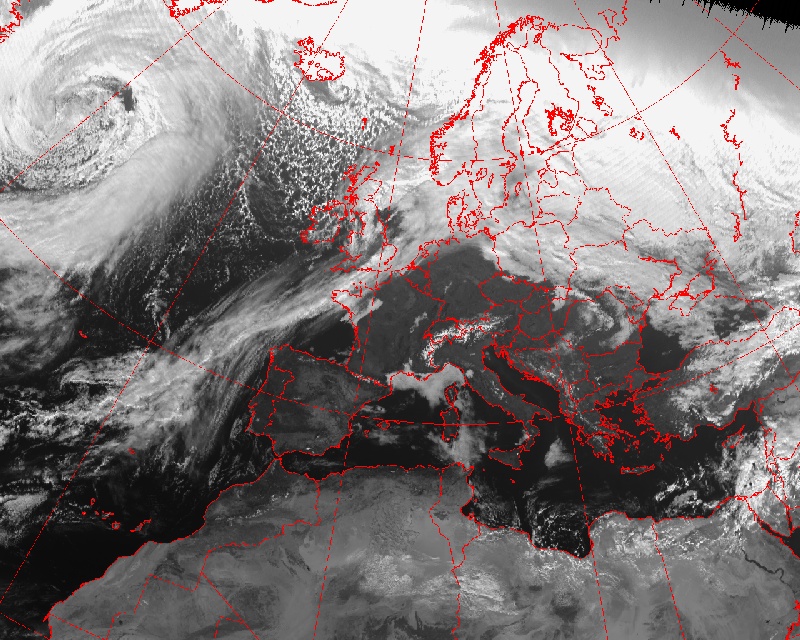
This was primarily due to the weather: an amazing winter with many many days of high pressure. See, for example, the EUMETSAT image of today (February, 7) which shows the high pressure dominion over Europe:

and this 360° panorama from our observatory:

These conditions allow a stable air conditions and very good seeing, often below 2″.

Posted in Uncategorized | Leave a comment

Last outburst of 29P/Schwassmann-Wachmann

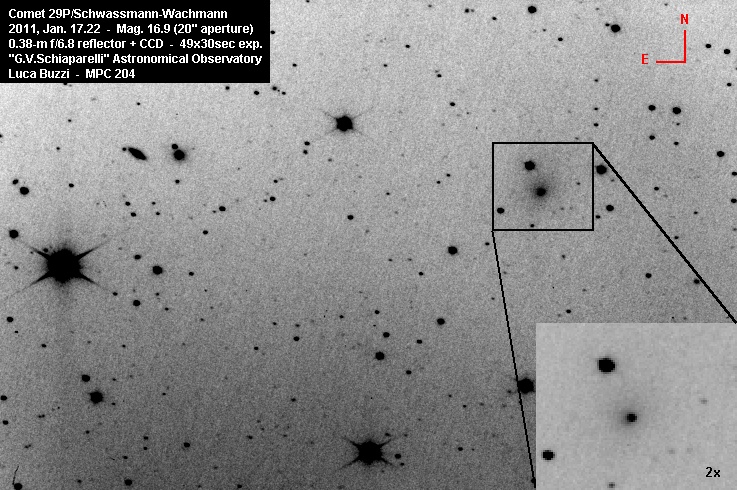
Discovered on 1927, Nov. 15 by Arnold Schwassmann and Arno Arthur Wachmann from Hamburg Observatory, Bergedorf, Germany, this comet is well known in the astronomical comunity for its periodic (although not regular) outbursts.
When in “quiescent” state its magnitude is around 17 (see image above), but several times per year it can reach mag 14-15 or even brighter (the brightest outburst was at mag. 10).
A highly changing surface processes (associated with transition from amorphous to crystalline water ice) are the suspected reasons for its behaviour. More information can be found here.
Its orbit around the Sun is almost circular (e=0.04) and its semimajor axis (a=5.99 AU) puts it just outside the orbit of Jupiter, with a current period of 14.7 years; for all its features it is catalogued as an active Centaur, with an estimeted diameter of around 30Km.
Maybe a spacecraft towards it will be not a bad idea! 🙂
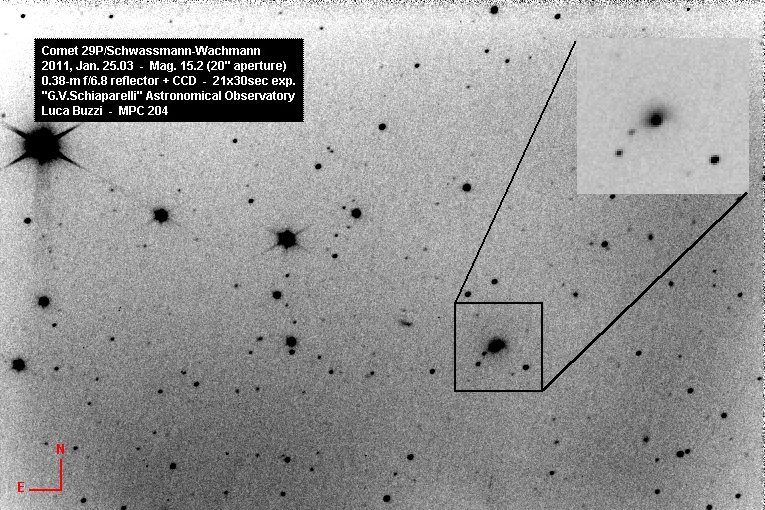
The image below shows the last outburst to date (discovered by Francois Kugel from A77 – Dauban on 2011, Jan. 24.18) in progress…

From our measures, its magnitude has changed from 16.9 on Jan. 17 to 15.2 on Jan. 25.

Posted in Uncategorized | Leave a comment

New comet C/2011 A3 (Gibbs)

Comet C/2011 A3 (Gibbs) was discovered on 2011, Jan. 15.51 by Alex Gibbs (during the course of the Catalina Sky Survey) in four 22-sec exposures taken with the 0.68-m Schmidt on Mt.Bigelow.
He described that the comet showed a 5″ tail in PA 270°, and its FWHM was 6.4″ larger than stars nearby.
Its cometary nature was confirmed by other CCD astrometrists, including us.
The discovery was announced on Jan. 17 on IAUC 9193 (subscription required), and the astrometry appeared on MPEC 2011-B07, together with a very preliminary parabolic orbital elements (perihelion around 2011, Oct. 4).
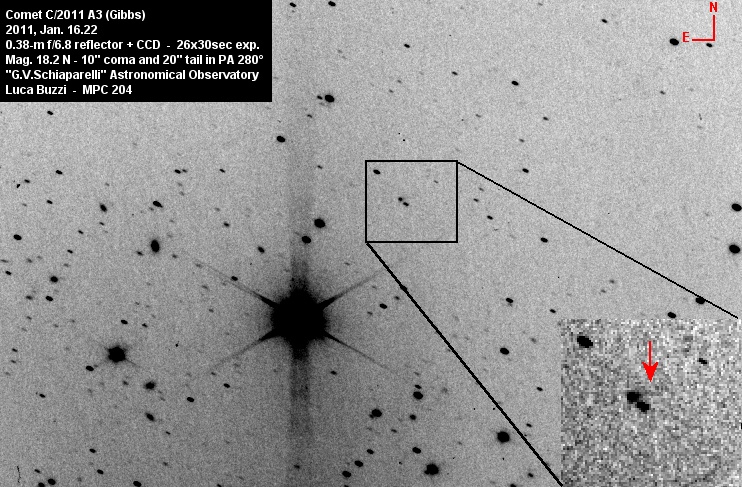
The image below was taken on 2011, Jan. 16.22, in the last part of the night, after some passing high clouds and after the Moonset. Seeing and transparency were good.
From my image, the coma was 10″ in diameter with a faint tail 20″ long in PA around 280°. FWHM was 35% larger than stars of similar brightness.

Posted in Uncategorized | Leave a comment