Observations of 2011 AH5

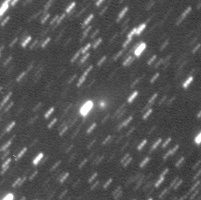
2011 AH5 was discovered by Steve Larson (during the course of the Catalina Sky Survey) on 2011, Jan. 08.34 with the 0.68-m Schmidt on Mt.Bigelow.
From our site the first clear night after its discovery was yesterday (between 11 and 12 of January) and it was on my target list. On that night there was also a request from Lance Benner of NASA radar team, because they planned to observe it with Goldstone the following day.

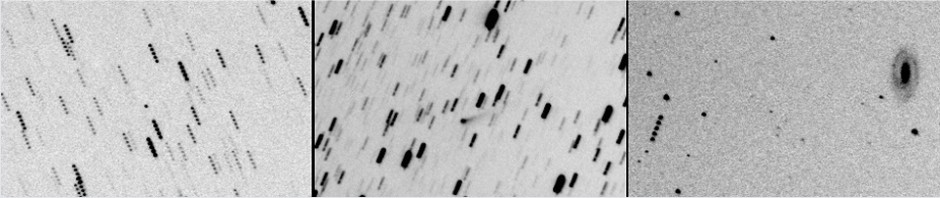
At the time of the image, 2011 AH5 was moving at 53″/min in constellation Canes Venatici at magnitude 17.9 R, heading toward closest approach to the Earth on Jan. 13 around 09 UTC, at a distance of 0.0086 AU (less than 1.3 million Km or 3.3 LD). From the H value its diameter should be around 20-40m.
Let’s wait for some images from the radar guys!
Posted in Uncategorized | 2 Comments

Goldstone radar observations of 2010 JL33

2010 JL33 was discovered by Rik Hill (during the course of the Catalina Sky Survey) using the 1.5-m reflector at Mt.Lemmon on 2010, May 06.37. It was promptly catalogued as a PHA.
The asteroid passed to perigee on 2010, Dec. 09 at a distance of about 0.0427 AU (6.4 million Km or 17 times the Moon distance).
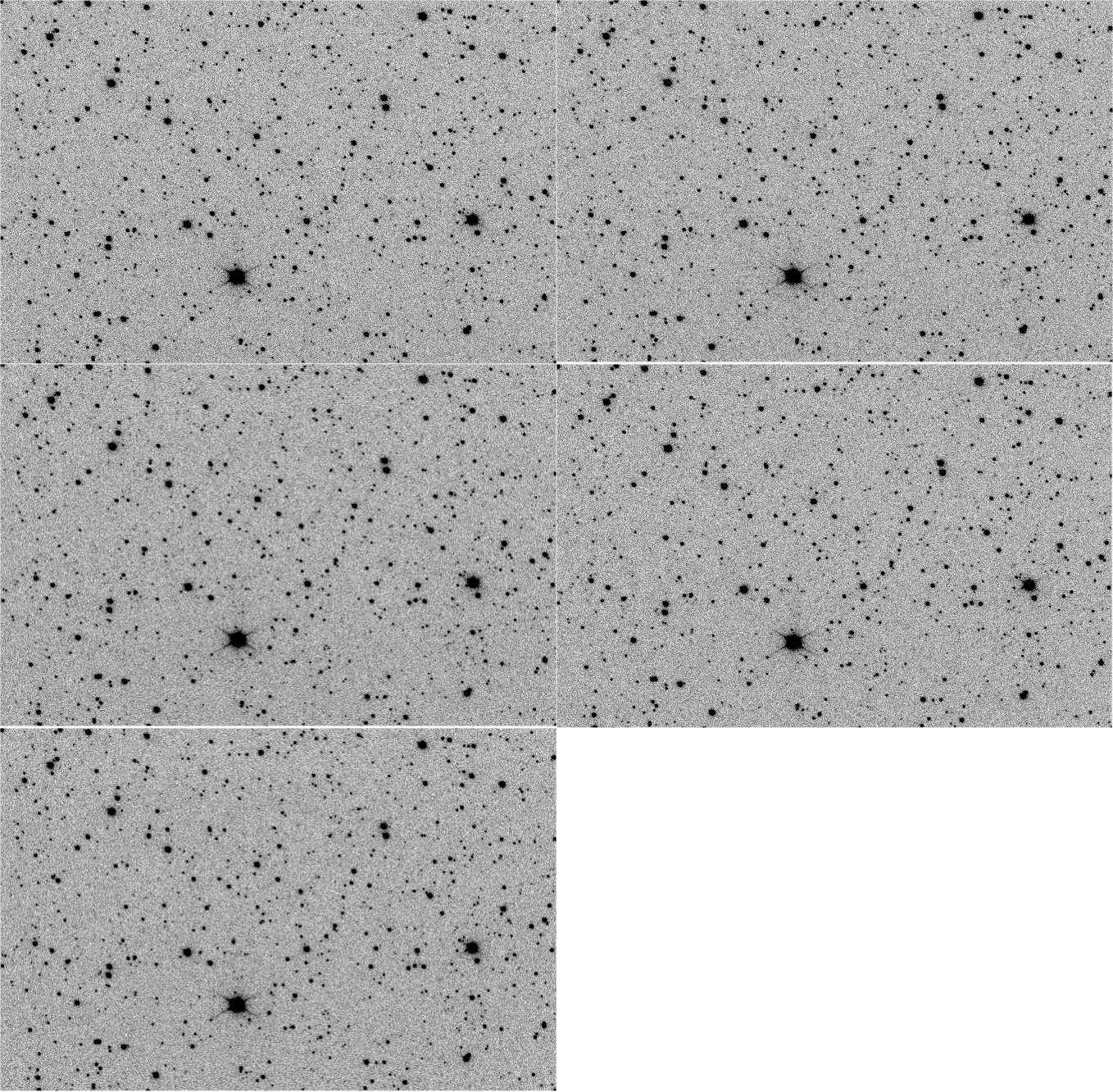
Here is an animation from our observation on 2010, Dec. 10.90:

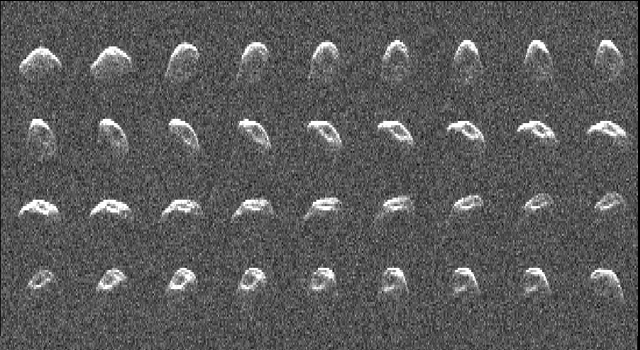
These images were taken just one day before NASA radar team imaged it with Goldstone antenna (see image below), revealing the shape of this 1.8-km asteroid.

The news can be seen at http://www.jpl.nasa.gov/news/news.cfm?release=2011-011.

Posted in Uncategorized | Leave a comment

Update on P/2002 VP94 and P/2010 WK

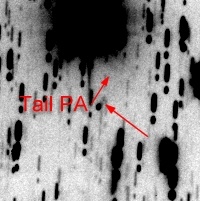
I’ve observed these two comets (whose cometary features was discovered by members of the T3 project at the end of December) on 2011, Jan. 02 and their activity now is well visible, especially for P/2002 VP94 (LINEAR).

It exhibits a tail at least 60″ long in PA 214°.
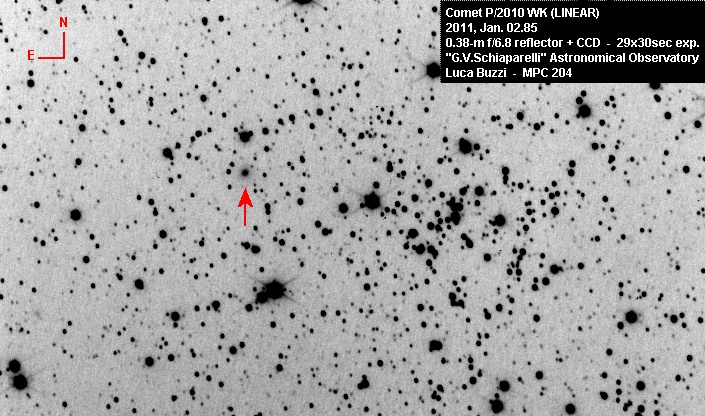
P/2010 WK (LINEAR) has no tail, but a round coma 30″ wide. Its strong central condensation has a FWHM of 4.4″, compared to 3.1″ of stars:


Posted in Uncategorized | Leave a comment

Our most productive night to date

The sky cleared in the afternoon of the first day of January, 2011, and it remained clear all night long, with a very good transparency and seeing, below 2″.
The night between 1 and 2 of January was our most productive night since 2001, with 190 astrometric positions sent to the MPC, regarding 41 NEAs and 21 (known) MBAs detected (I know, Catalina makes 190 obs. in less than half an hour or so, but for us is a very good result!… 🙂

Posted in Uncategorized | Leave a comment

Evolution of the outburst of minor planet (596) Scheila

(596) Scheila was discovered on 1906, Feb. 21 by August Kopff from Heidelberg-Königstuhl Observatory, Germany. It is a “normal” asteroid inside the Main Belt between Mars and Jupiter (a = 2.93 AU, e = 0.17, i = 14.66°), with a diameter around 100Km.
On 2010, Dec. 11, Steve Larson of the Catalina Sky Survey discovered a coma around it, and it was soon followed by other observers, including us.
Archived Catalina images suggest that this outburst may have started around December 3, 2010, when Scheila appeared a little brighter than expected but with no obvious coma.
Just only for this activity, Scheila became a member of the Main-Belt Comets.
Here are our first image of the object, taken the day after the discovery of the coma:

The “cloud” of dust is clearly visible, also on images taken after two days, on 2010, December 14:

Our last image was taken on 2011, Jan. 02.18:

The coma is only barely visible as a sort of faint cloud around the asteroid. The outburst is definitely finished.

CBET 2632, issued on 2011 Jan. 12, reports, among other things, about spectroscopic observations of (596) Scheila obtained with FORS2 attached to one of the VLT by astronomers from Liege University. Spectra does not show any extended cometary gaseous emissions, but only a spatially extended continuum due to dust-scattered sunlight.
Those preliminary results are in favor of a collisional scenario to explain the outburst of (596) Scheila, rather than a cometary driven activity.

Posted in Uncategorized | Leave a comment

Discovery of cometary nature of 2010 WK

2010 WK was discovered by the LINEAR survey on 2010, Nov. 17, and although its orbit looked like cometary in appearance, it was not in our T3 targets list because its MOID with Jupiter was 1.015 AU (our limit is set to 1 UA).
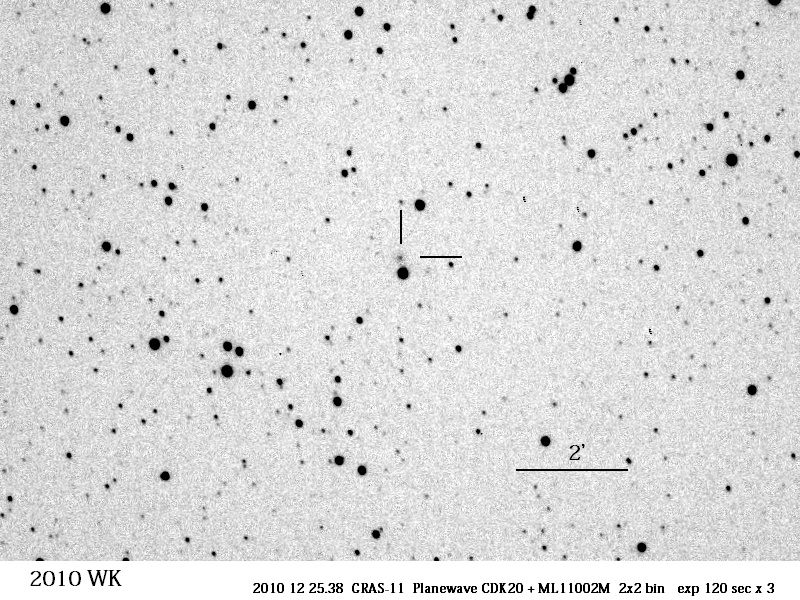
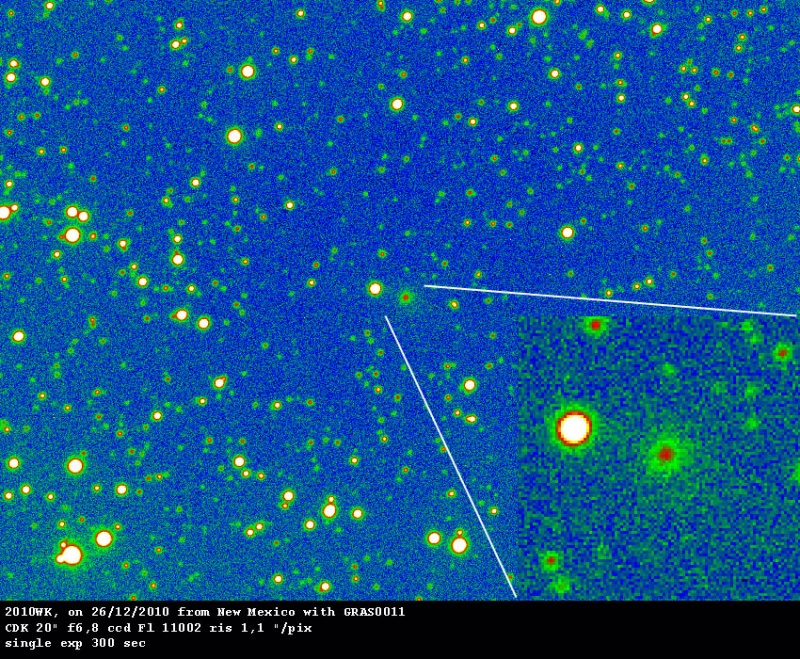
The cometary appearance was first discovered by Hidetaka Sato, member of the T3 project,  remotely with GRAS 0.50-m f/6.8 reflector from New Mexico, and then confirmed by several other members, including Enrico Prosperi, Luca Buzzi, Sergio Foglia et al., Leonid Elenin and Rolando Ligustri.
On 2010, Dec. 27 the Central Bureau for Astronomical Telegrams published CBET 2607 with the discovery circumstances (subscription required).
The astrometry and the updated orbital elements were published on MPEC 2010-Y30.

The original discovery image by H. Sato:


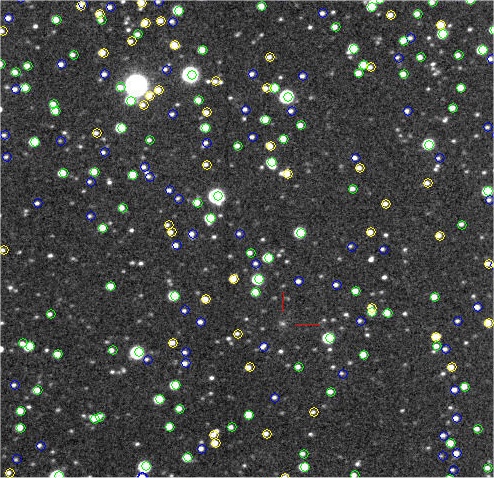
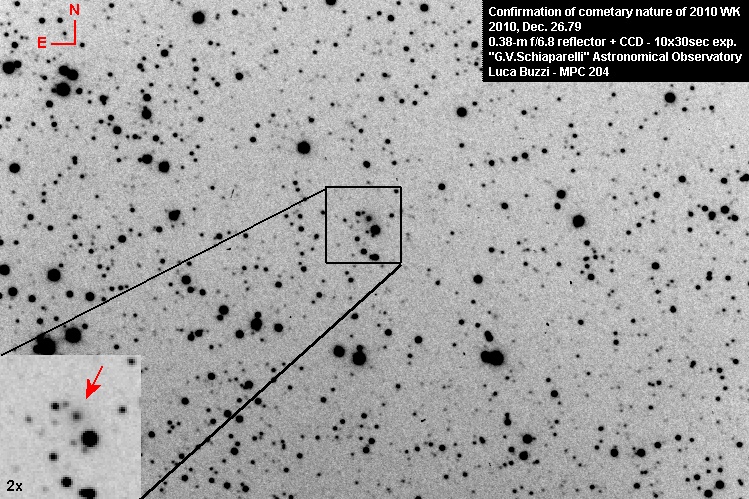
Confirmation images:
“prediscovery” image by E. Prosperi (160) on 2010, Dec. 12.0:


by R.Ligustri remotely from GRAS – New Mexico (H06):


by L. Elenin remotely from ISON-NM (H15):


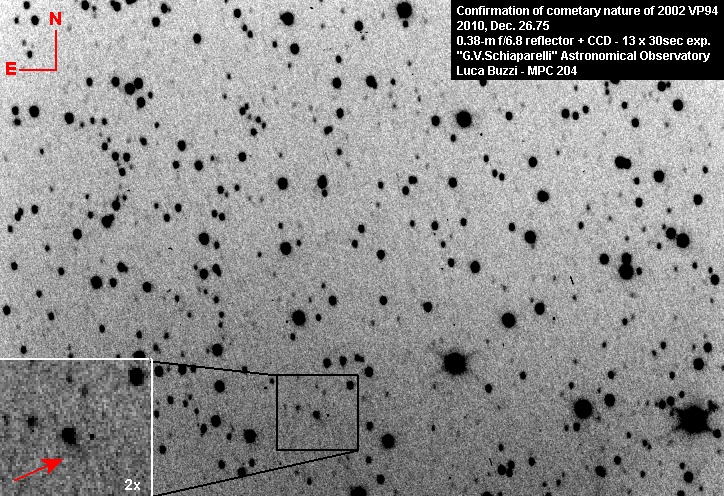
by L. Buzzi from Schiaparelli Observatory (204):

Posted in Uncategorized | Leave a comment

Discovery of cometary nature of 2002 VP94

2002 VP94 was discovered by the LINEAR survey on 2002, Nov. 5, and the features in its orbit put it in the T3 targets list.
The cometary appearance was first discovered by R.Behrend et al with the 0.80-m reflector from the observatory of Haute-Provence, and then confirmed by several members of the T3 project, including Hidetaka Sato, Luca Buzzi, Sergio Foglia et al. and Rolando Ligustri.
On 2010, Dec. 27 and 30 respectively, the Central Bureau for Astronomical Telegrams published CBET 2606 and IAUC 9190 with the discovery circumstances (subscription required).
The astrometry and the updated orbital elements were published on MPEC 2010-Y29.
Now this comet is known as P/2010 V3 (LINEAR).

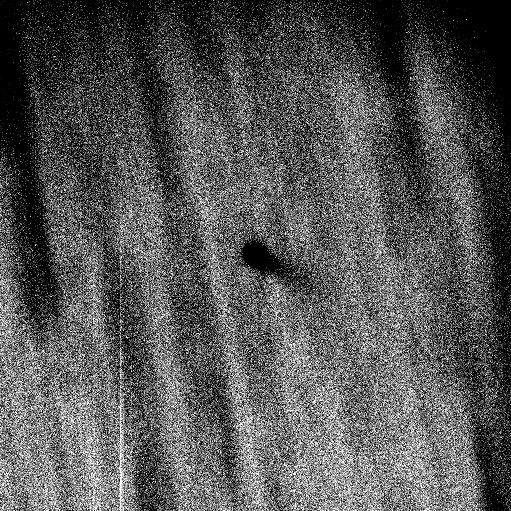
The original discovery image by R. Behrend et al:

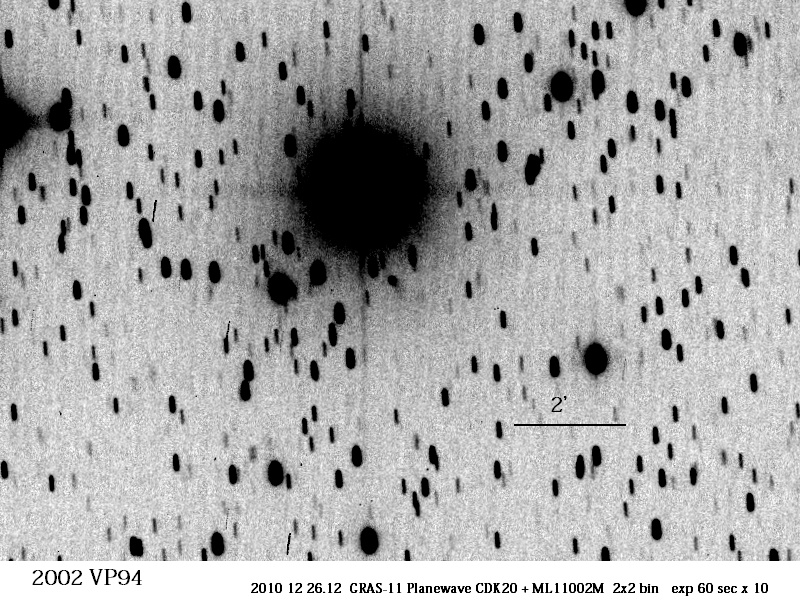
Confirmation images:
Hidetaka Sato remotely from GRAS – New Mexico (H06):

Leonid Elenin remotely from ISON-NM (H15)
(image must be flipped):

Luca Buzzi from Schiaparelli Obs. (204):

Posted in Uncategorized | Leave a comment